I've now produced three publications: a full-length historical mystery (A Pig in the Roses), a 10,000-word adventure for children (The House on Athene Street) and a collection of previously-blogged historical short stories (Voices from the Past). So what exactly is the particular pleasure of writing short stuff?
First, the obvious. It's shorter. There's no need to develop the long plot strands, no need for the complex building of tension and interest over a long story arc. But is it easier to write? I'm not so sure. There still has to be the same care in developing character and atmosphere, perhaps more because of the shorter space available to create the effects. I tend to think in scenes, often deriving from a single image or character, and usually find short stories arriving in my head mostly complete bar the actual writing, which which is handy for someone who hates plotting as much as I do.
The stories in Voices from the Past are a varied lot, some very short, some humorous, a ghost story or two. One story, Hoard, set in Roman Britain, has already appeared on this blog and here's a bit from Hallveig, a brief sketch set in medieval Iceland :
Below her the farmhouse sat comfortably into the fellside, thick turf walls on a timber frame buried in the earth, the floor inside lower than the grass cropped outside by Gelli’s sheep. Inside Hallveig’s sullen daughter Rannveig, fifteen and ripe for marriage, would be taking bread from the oven, practising for her husband. Red Gelli and his sons had been out after the fish all day on the breathing sea to the south, opposite to the thunder.
Hallveig smiled and picked up her spade. She remembered Gelli in his young days, burning with the stories brought back by the companions of Leif Eriksson, tales of the seas beyond Greenland, of the vine-country, of the skraelings with their skin boats and red hair and furs. They had taken ship together, sturdy young man and wife and baby sons going a-viking, sailing west late in the season to find new lands unknown to Leif Eriksson. Several days out at sea they hit seas like mountains, seething and roaring, sucking at the keel of the ship, winds that tore the sail and lifted the waves inboard. Back they came through icebergs striped like the jaws of whales, wallowing in the tide with nothing to show for it, and never sailed out of sight of land again unless it was after the fish.
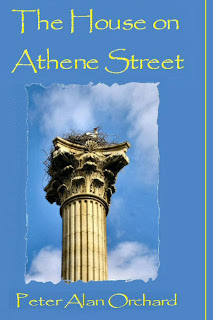
The House on Athene Street, like my whodunnit A Pig in the Roses, is a kidnap-and-chase plot set in Athens in the fifth century BC. Since it's aimed at the 9-12s, the main aim was to keep the story moving, the tone light and the dialogue perky. In this scene from the subplot the parents, Helene and Lysikles, have arranged a social visit to a family whose unprepossessing son may make a serviceable husband for the hero's sister, Xanthippe, when she's of age (around the mid-teens in ancient Greece). Helene is determined but Xanthippe is just eleven and less than enchanted, so Hermippos, the thirteen-year-old hero, decides to make mischief:
Oh, wonderful, Xanthippe thought. The great get-Xanthippe-married-off-to-the-Nose conspiracy is up and running. And here he comes, the great one himself.
Sophilos appeared in the doorway, a gangling youth of nearly seventeen with a vague smile lighting up those parts of his face not occupied by nose. He rubbed hands on his tunic, leaving soil stains, and nodded shyly to the visitors.
‘I’ve been chasing the pig out of the vegetable patch,’ he said. ‘It likes onions.’
Xanthippe felt a giggle rising up her body and threw her brother an imploring look. Save me, it said. Please don’t let me laugh at him!
Hermippos marched over to Sophilos and grabbed him by the arm. ’Tell me about the pig, Sophilos,’ he said firmly. ’And have you started cadet training yet? It starts at your age, doesn’t it? I can’t wait to start, but I’m too young.’ Together the boys sauntered out into the sunlight. ’Is that the pig over there,’ Hermippos went on happily, ’digging up turnips with its nose?’
Her fingers clasped over her mouth and tears of silent laughter in her eyes, Xanthippe heard her mother say, ‘There, Lysikles, I said the boys always got on well together.’
The House in Athene Street is $2.99, Voices from the Past is $1.99 and A Pig in the Roses is $3.99. All are Smashwords premium titles and available in all the usual ebook formats. Details are on my Smashwords page and at http://www.peteralanorchard.net/, where you'll also find a short story, Starlight, for $0.99.
Peter
http://www.peteralanorchard.net/
http://www.twitter.com/peteraorchard
http://www.smashwords.com/profile/view/PeterAlanOrchard
Showing posts with label Peter Alan Orchard. Show all posts
Tuesday, 17 May 2011
Thursday, 22 July 2010
Peter Alan Orchard: 'Hoard' - short story
Hoard
His leggings caked with dust and burrs from the ploughed field, his tunic stinking of pigs from the sty behind the house, Messicus trudged into the kitchen and sat heavily at a solid oak table. A spring breeze hustled fruit trees outside in their pots, cuffing one to the ground, and banged a loose shutter on the kitchen window. A brick-red tile lifted from the roof and slid, scraping, to the gutter.
Relaxed and alone, he poured beer into a mug – his mug, a treasure from his days in the legion before the order came for the fit and able to leave the Britlets to their fog-bound island - and drained half of it in a draught. Retired out of the Twentieth with a theatrical limp now agonised by arthritic joints, Messicus was left behind, widowed, master of his veteran’s allotment, a parcel of land for a family and a small farmhouse with a courtyard, an imitation of Romanness in northwest Britain.
Through the rush of wind across the field came voices like birds: Severa, his daughter, and her young man Gavo, back from who knows where.
‘Father, look!’ Severa piped happily. ‘Look what Gavo found!’
Messicus looked across the kitchen and Gavo looked back, darker-skinned than Severa and heavy in the eyebrows, son of a north African decurion and a local woman. ‘Have you been out in the woods with my daughter, young man?’
‘No, sir.’ Gavo looked shocked at the question. ‘I was foraging for firewood, for my mother.’
And I’m a three-legged goldfish, Messicus thought. ‘Show me,’ he said.
Severa laid their prize clanking on the table: three or four gold coins, a dozen silver ones, a silver bowl with inlaid decoration. ‘There’s more,’ Severa went on, ‘by the edge of the wood, where the stone road goes past on the way to the fort. There’s a rowan tree with a rock tangled in the roots. It’s there.’
Messicus gazed at the tiny hoard, for a moment unable to look away. Then he clasped his hands behind his grizzled head and looked up at the ceiling, counted spiders, measuring cracks, remembering.
‘Is there something wrong?’ Gavo asked. ‘Have we done something we shouldn’t?’
Severa cut him short. ‘Can we have the coins, father? Please? They will help so much towards – ‘
‘I know what towards, Severa,’ Messicus said, still staring at the ceiling. ‘Towards marrying Gavo. Take them, they’re coins. But put the rest back. No, don’t look at me like that. I’ll tell you why. Come with me.’
He picked up his mug and the three of them moved into the next room. Under the dust and muddy boot-marks lay a mosaic floor, the handiwork of a local artisan: key-patterns not quite as crisp as in the better villas, a dog with legs too short, a minor deity with his rapturous expression spoilt by a slight twist in the mouth. On each side stone benches lined the walls, and from beneath one of them Messicus drew a gaming board cross-hatched with lines cut into the wood.
‘A game of robbers? Now?’ Gavo asked. Severa put her finger to her lips, but the boy feigned not to notice. ‘Why?’
‘No, Gavo, not now,’ Messicus said. ‘But I was playing then, before you were born, Severa, against a Sarmatian cavalryman, Julius Valerius. His people came from the wild, cold plains out beyond Gaul, but there had been Sarmatians serving here for generations, all horsemen, and even other Sarmatians reckoned his skill with horses was almost uncanny.
‘We were old companions, in battle and in the hunt, but we met over the gaming board and fought each other like old enemies. Each little glass piece became a living warrior, no holds were barred, no cunning was too low to indulge at the other’s expense.’ Messicus grinned. ‘We had some rare games, and drank a lot. Decent wine, not this stuff.
‘It was in this room, the last game I played with Julius Valerius. We sat on this bench, with the board between us, and went on for hours. It got dark. I had torches lit, and the brazier because it was winter. We were at stalemate, going nowhere. Then he put his wine down on the floor and stood up.
‘”Giving up?” I asked. ”You say you’d rather fall under a horse than lose to me, Sarmatian.” Then I saw his face.
‘”I’m going tomorrow, Messicus,” he said. “With the draft, to Gaul against the Visigoths. Stilicho’s orders. No peace while Alaric’s on the march against Rome. I’ve buried my stuff.”
‘”What stuff?” I said. “Have you got stuff?” I don’t know why. It must have been the wine talking, because everyone’s got stuff they need to keep safe, and better buried here than stolen on the journey south.
‘He sat down again and made one more move, one glass piece one square to the right. I was trapped. My strategy was falling apart, and my most important soldier, squeezed between two of his pieces, was about to be taken – but Julius never saw it. He swept his hand across the board, jumped up and began to pace the room. “Yes, I’ve buried it, all of it, Messicus, and I’m telling no-one! One day I’ll be back and it’ll still be there, still mine.”’
‘You can tell me,” I said. “I can keep it safe. I’m not leaving, not with my wound.” ‘
‘”We’ve fought the same enemies, Messicus, and served the same Rome, but between ourselves all we do is cheat each other. I know it’s just a game, but there it is. I’m telling no-one where my stuff is hidden, not even you. Goodbye.”’
‘He stalked out of the room and I never saw him again. He never came back. As for his “stuff”, Severa is holding some of it. The coins he won from me and men like me, at least the smaller ones. The gold – he must have cheated the camp commander for those.’
Messicus waved his arm at the door and watched Severa lead Gavo through it, out into the sun. He finished his beer, thew the dregs into the yard and busied himself about the farmhouse for the rest of the day.
As evening fell, a brisk red evening with a cutting wind, Messicus took a shovel and a leather bag and went looking for a rowan beside the road into the fort. There he found what was left of Julius Valerius’ treasure, hidden under leaves and damp, grey earth. He put back the silver bowl, laid the gaming board on top and set out the pieces as he remembered them at the moment when the Sarmatian left his house and rode away to fight Alaric’s Visigoths.
He stood up gingerly on stiff legs and started to shovel soil back into the hole. Then he stopped, knelt down again and moved a single glass warrior one square to the left.
http://www.peteralanorchard.net
Subscribe to:
Posts (Atom)


Welcome to Lindsay's Romantics, where we post on all kinds of romance topics.